Neuroscience of Reaction Time: Brain Processing Speed & Reflexes
December 5, 2025 | By Marcus Adler
Ever clicked your mouse in a game a split-second too late? Or slammed on the brakes just in time? These moments are defined by your reaction time—the lightning-fast conversation happening inside your nervous system. But have you ever wondered what happens in your brain during that split second?
Quick reflexes are just the surface. The real magic happens inside your brain during that split-second process—let's unpack this fascinating journey. From the instant your eyes see a stimulus to the moment your muscles respond, a complex series of events unfolds. In this guide, we'll explore the neuroscience of reaction time, breaking down how your brain turns thought into action.
Before we dive into the science, it's helpful to know your own baseline. You can discover your current speed with a simple, free reaction time test and see these principles in action.
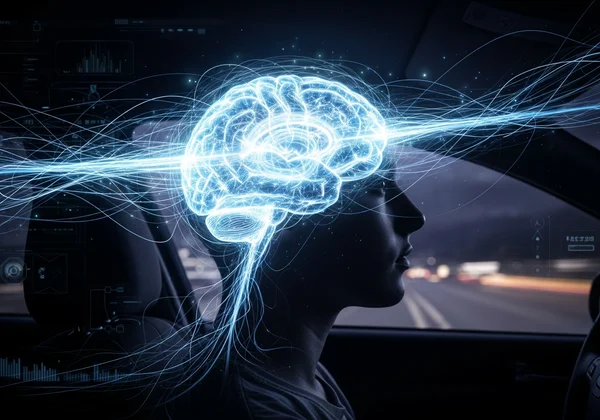
The Neural Pathway of Reaction: From Sensory Input to Motor Output
Think of your nervous system as a high-speed biological highway. A reaction is a message that travels along this highway at incredible speeds. The entire process, from seeing something to physically reacting to it, follows a clear and precise neural pathway. Let's trace this journey step-by-step.
Detecting the World: How Sensory Organs Register Stimuli
Every reaction begins with a stimulus—something you see, hear, or feel. For an online reaction test, the stimulus is visual: a box on your screen changing color from red to green.
This process starts in your eyes. When the color changes, light hits your retina, a layer of tissue at the back of your eye filled with specialized cells called photoreceptors. These cells act as translators, converting the light energy into tiny electrical signals. This is the very first spark of a reaction. The stimulus has been detected and transformed into the language of your nervous system.
The Speed of Thought: Neural Transmission to the Brain
Once the electrical signal is created, it can't stay in the eye. It needs to reach the brain's command center for processing. The signal travels from the optic nerve down a long chain of nerve cells, or neurons.
Each neuron passes the message to the next, like a baton in a relay race. This transmission occurs at incredible speeds. A fatty substance called myelin sheath insulates the nerve fibers, helping the signal maintain its strength. The signal zips along this pathway until it reaches the occipital lobe at the back of your brain—the region responsible for processing visual information.
Brain's Command Center: Processing Stimuli & Decision Making
The signal has arrived at its destination: the brain. This is where simple detection turns into conscious recognition and a decision to act. Your brain identifies the signal (the box is now green!) and determines that a response is required (I need to click!). This central processing is the most variable part of reaction time and is where our cognitive abilities truly shine.
Simple vs. Choice Reaction Time: Different Paths, Different Speeds
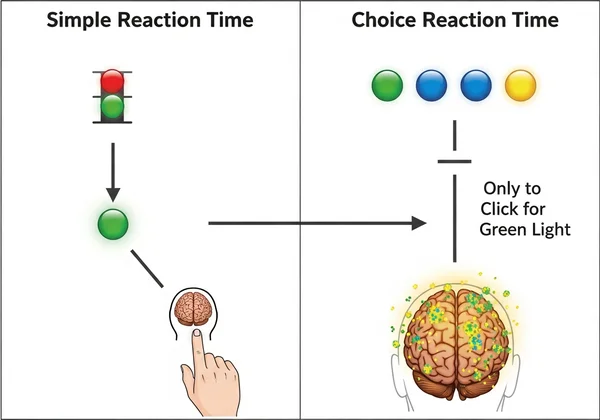
Not all reactions are created equal. Neuroscientists distinguish between two main types, and the difference lies in the amount of brainpower required.
- Simple Reaction Time: This is a response to a single, expected stimulus. The test on our website is a perfect example. You know the box will turn green, and your only job is to click when it does. The neural pathway is direct and quick because there's no decision to make. It’s a straight shot from seeing the signal to initiating the action.
- Choice Reaction Time: This involves multiple stimuli and requires you to make a decision before acting. Imagine a test where the box could turn green, blue, or yellow, and you only click for green. Your brain must first identify the color and then decide if it's the correct one to act on. This extra cognitive step engages more complex brain areas, naturally making choice reaction time slower than simple reaction time.
This distinction is crucial in everyday life, from driving (choosing to brake or swerve) to competitive gaming (choosing which ability to use). Seeing how you perform in a controlled setting can be insightful; you can take the test to measure your simple reaction speed.
From Decision to Action: Initiating Motor Response
Once your brain has made the decision to act, it's time to send the command to your muscles. The brain's motor cortex—which controls voluntary movement—then activates. It sends a new electrical signal down your spinal cord.
This signal travels out to the peripheral nerves in your arm and hand, finally reaching the muscles that control your finger. The signal instructs these muscles to contract, causing your finger to press down on the mouse. The action is complete. This entire journey, from eye to brain to finger, typically happens in less than a quarter of a second.
Factors Influencing Brain Response Speed and Reaction
Your reaction time is not a fixed number. It's a dynamic metric that can change from day to day, or even hour to hour. Both internal and external factors can significantly influence your brain processing speed and, consequently, your reflexes. Understanding these factors is the first step toward improvement.
Internal Regulators: Age, Fatigue, and Attention's Impact
Your internal state plays a massive role in how quickly you can react. Three of the most significant internal regulators are:
- Age: Reaction time follows a predictable curve throughout life. It improves during childhood and adolescence, peaks in your early to mid-20s, and then gradually begins to slow down as part of the natural aging process.
- Fatigue: A tired brain is a slow brain. When you're sleep-deprived, your neurons fire more slowly and communication between brain regions becomes less efficient. This directly impacts how quickly you can process information and send motor commands.
- Attention: A focused mind is a fast mind. If you are distracted or multitasking, your brain has to divide its resources, slowing down its ability to detect and respond to a specific stimulus. Peak performance requires undivided attention.
External Influences: Stimulants, Environment, and Training
What you put into your body and the environment around you also affect your reaction speed. Fortunately, many of these factors are within your control.
-
Stimulants: Substances like caffeine can temporarily increase alertness and decrease reaction time by making your nervous system more excitable.
-
Environment: A calm, quiet environment free of distractions allows you to focus better, leading to faster responses. This is why professional gamers often use noise-canceling headphones.
-
Training: This is the most powerful factor. The brain possesses an incredible ability known as neuroplasticity. This means it can change and adapt based on your experiences. By repeatedly practicing a task, you can strengthen the specific neural pathways involved. Regular practice with a reaction time trainer can make your responses more efficient and almost automatic.

Unlock Your Brain's Potential: Understanding & Enhancing Your Reflexes
Your reaction time is more than just a number; it's a direct window into the health and efficiency of your nervous system. We've journeyed from the sensory spark in your eye, along the neural highway to your brain's command center, and back down to the muscles in your hand.
While genetics and age might set the starting line, your brain's processing speed is anything but fixed. Through focused training, proper rest, and paying attention to your health, you can actively enhance your reflexes. Once you understand the science behind reaction time, you gain the tools to hack your own reflexes.
Are you ready to see where you stand and begin your journey toward faster reflexes? Put this knowledge into practice. Measure your reaction speed for free and discover your brain's true potential.
Neuroscientific FAQs: Your Brain and Reaction Time
Is Reaction Time Purely Genetic or Can it Be Improved Neurologically?
Reaction time is a combination of both. Genetics provides a baseline potential for how quickly your nervous system can operate. However, neuroplasticity allows for significant improvement. Through consistent practice and training, you can strengthen neural connections, making your brain's response more efficient and measurably faster.
What Causes Slow Reaction Time from a Brain Processing Standpoint?
From a neurological perspective, slow reaction time can be caused by a bottleneck at any stage of the neural pathway. This could be slower signal transmission from the eyes, inefficient processing within the brain (due to fatigue or lack of focus), or a delayed motor command to the muscles. Often, it's the central processing and decision-making step that introduces the most delay.
How Does the Brain Differentiate Between Simple and Choice Reactions?
For a simple reaction (one stimulus, one response), the neural pathway is very direct, almost like a reflex. For a choice reaction, the brain must engage higher-level cognitive functions. The signal is routed to areas like the prefrontal cortex, where it weighs options and makes a decision before sending a command to the motor cortex. This extra step is why choice reactions are always slower.
What is the Fastest Human Reaction Time According to Neurological Limits?
The theoretical limit for a simple visual reaction is around 100 milliseconds (ms). However, this is extremely rare and at the edge of human potential. For most people, a score between 200-270ms is average. Competitive gamers and athletes often train to get their scores consistently below 200ms. It's always interesting to check your own score and see how you compare to these benchmarks.