How to Calculate Reaction Time: Formulas, Ruler Test, and Real Examples
June 18, 2026 | By Marcus Adler
Learning how to calculate reaction time is easier once you know which situation you are measuring. A screen-based test records the delay between a stimulus and your click. A ruler drop test uses free-fall distance. A driving example uses distance and speed. A chemistry question may not mean human response time at all; it often means the time interval used to calculate reaction rate. This guide separates those cases, shows the main formulas, and gives worked examples you can check against your own online reaction time test results.
What Reaction Time Means Before You Calculate It
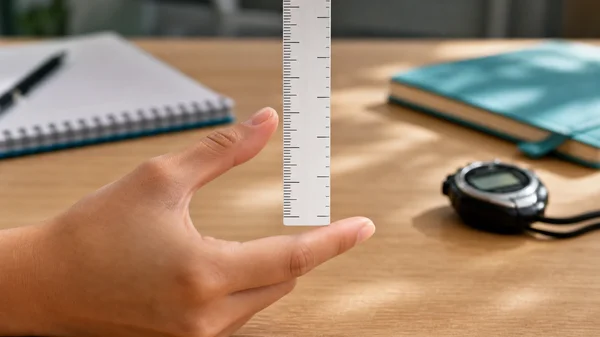
Reaction time is the time between a stimulus and the start of a response. In a simple visual test, the stimulus might be a color change on a screen, and the response might be a mouse click or key press. In a ruler drop test, the stimulus is the moment the ruler begins falling, and the response is your fingers closing around it.
The key is to define the start and end points before doing any math. If you change the start point, you change the number. For example, a driving calculation may measure the delay from seeing a hazard to pressing the brake pedal. A sports drill may measure the delay from a signal to a sprint start. A lab graph may show a flat delay before motion begins.
Most human reaction time values are reported in seconds or milliseconds. One second equals 1,000 milliseconds, so 0.2 seconds is 200 ms. That conversion matters because calculators, physics formulas, and online tests may use different units.
The Core Reaction Time Formulas
There is no single formula that fits every reaction time question. Choose the formula that matches the information you already have.
| Situation | Formula | Use it when |
|---|---|---|
| Direct timing | reaction time = response timestamp - stimulus timestamp | A timer, app, or experiment records both moments |
| Ruler drop test | t = sqrt(2d / g) | You know how far the ruler fell before being caught |
| Distance and speed | t = d / v | You know distance traveled during the reaction delay and speed |
| Average reaction time | average = sum of trials / number of trials | You have several valid reaction time attempts |
| Chemistry rate context | rate = change in amount / time | The question is about reaction rate, not human reflex speed |

Keep units consistent. If distance is in meters and acceleration is in meters per second squared, the answer is in seconds. If speed is in feet per second and distance is in feet, the answer is also in seconds. Most errors come from mixing centimeters, meters, miles per hour, and milliseconds without converting them first.
How to Calculate Reaction Time With a Ruler
The ruler drop method is a classic physics activity because the ruler falls under gravity. You measure the distance it falls before you catch it, then convert that distance into time. It is simple, cheap, and useful for learning the relationship between distance and time, although it is less precise than a digital reaction speed benchmark.
Use this formula:
t = sqrt(2d / g)
In the formula, t is reaction time in seconds, d is the falling distance in meters, and g is gravitational acceleration, about 9.81 m/s^2.
Here is a worked example:
- You catch the ruler after it falls 20 cm.
- Convert 20 cm to meters: 20 cm = 0.20 m.
- Substitute into the formula: t = sqrt(2 x 0.20 / 9.81).
- Calculate inside the square root: 0.40 / 9.81 = 0.0408.
- Take the square root: t = 0.202 seconds.
- Convert to milliseconds: 0.202 x 1,000 = 202 ms.
So, if the ruler fell 20 cm, the estimated reaction time is about 202 ms. If it fell farther, the reaction time was longer. If it fell a shorter distance, the reaction time was faster.
To reduce random error, repeat the test five times and use the average. Ignore obvious false starts, such as closing your fingers before the ruler moves, because those are anticipation errors rather than true reactions.
How to Calculate Reaction Time With Distance and Speed
When a person, car, or object keeps moving during a delay, reaction time can be calculated from distance and speed:
t = d / v
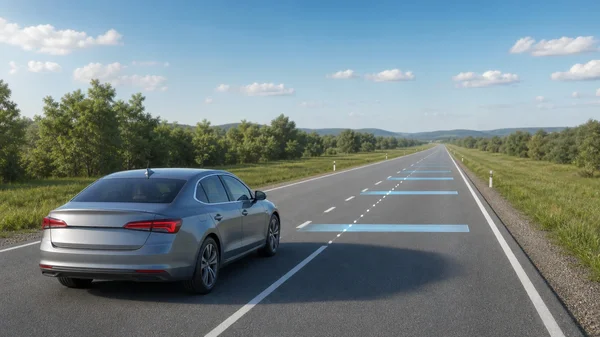
Here, t is reaction time, d is the distance traveled during the reaction delay, and v is speed. This is the most useful formula for driver reaction time questions, stopping distance examples, and motion-system problems.
Example with meters:
- A vehicle travels 18 meters before braking begins.
- Its speed is 24 meters per second.
- t = 18 / 24 = 0.75 seconds.
That means the driver reaction time in this simplified example is 0.75 seconds. In real driving, the total stopping distance also includes braking distance after the driver responds. Reaction distance and braking distance should not be treated as the same thing.
Example with miles per hour:
- A car travels 88 feet during the driver's reaction delay.
- The speed is 40 mph.
- Convert speed: 40 mph x 1.467 = 58.68 ft/s.
- t = 88 / 58.68 = 1.50 seconds.
This method is educational, not a personal safety judgment. Driver response depends on attention, visibility, surprise, road conditions, vehicle condition, and many other factors. Use conservative assumptions for safety planning, and rely on qualified guidance for legal, medical, or road-safety decisions.
How to Calculate Average Reaction Time
One reaction time attempt can be noisy. You might blink, anticipate the stimulus, hesitate, or click slightly late. Average reaction time gives a more stable picture because it combines several valid trials.
Use this formula:
average reaction time = total reaction time / number of valid trials
Suppose your five valid trials are 225 ms, 240 ms, 218 ms, 231 ms, and 236 ms.
- Add the trials: 225 + 240 + 218 + 231 + 236 = 1,150 ms.
- Divide by 5: 1,150 / 5 = 230 ms.
Your average reaction time is 230 ms.
For everyday testing, the average is often more useful than the fastest single attempt. The fastest attempt may reflect a lucky timing pattern, while the average better represents repeatable performance. If one trial is clearly invalid, such as a click before the stimulus appears, remove it and note why you removed it.
You can also compare mean and median. The mean adds all trials and divides by the count. The median is the middle value after sorting. Reaction time data often has occasional slow trials, so the median can be helpful when one lapse pulls the mean upward.
How to Calculate Reaction Time From a Physics Graph
Physics graphs can show reaction time in a few different ways. The method depends on what the axes represent.
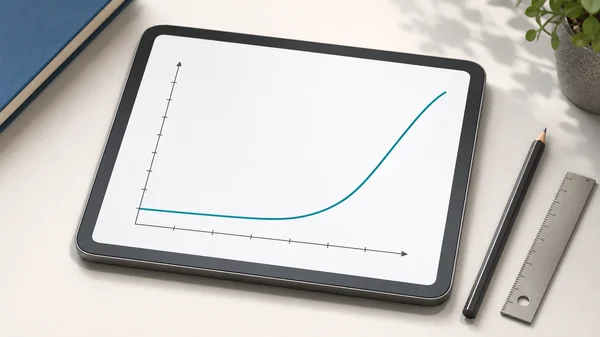
If the graph shows position versus time for an object that starts moving after a delay, reaction time is the time from the stimulus marker to the point where position begins to change. Look for the flat part of the graph before motion starts.
If the graph shows velocity versus time, reaction time may be the interval between the stimulus and the first clear change in velocity. For example, if a runner hears a signal at 0.00 seconds and the velocity graph begins rising at 0.18 seconds, the reaction time is about 0.18 seconds.
If the graph shows distance traveled during a reaction delay, use the distance-speed formula. For constant speed, reaction time is distance divided by speed. On a distance-time graph, speed is the slope, so you may need to find the slope first and then calculate t = d / v.
When reading from a graph, estimate carefully. Check the axis scale, units, and whether the graph uses seconds or milliseconds. If the graph has a curved transition instead of a sharp start, choose a consistent rule such as the first clear departure from the baseline.
How Chemistry Reaction Time Is Different
Searches for how to calculate reaction time in chemistry often mean something different from human reaction time. In chemistry, the question usually concerns how long a chemical reaction takes, how reaction rate changes, or how concentration, volume, absorbance, or temperature changes over time.
For many chemistry problems, the central formula is:
rate = change in quantity / time
The quantity might be concentration, gas volume, mass, color intensity, or absorbance. If concentration changes from 0.80 mol/L to 0.50 mol/L over 60 seconds, the average rate of change is:
(0.80 - 0.50) / 60 = 0.005 mol/L/s
That is not a human reaction time. It is a chemical reaction rate. If a chemistry worksheet asks for reaction order from concentration and time, it may require rate-law analysis, half-life patterns, or a graph of concentration data. In that context, "reaction time" is usually the elapsed time in the experiment, not the speed of a person's response to a stimulus.
Common Calculation Mistakes to Avoid
The most common mistake is using the right formula with the wrong units. A ruler distance of 20 cm must become 0.20 m before using g = 9.81 m/s^2. A vehicle speed in mph must become ft/s or m/s before using distance divided by speed.
Another mistake is confusing reaction time with total task time. In driving, reaction time ends when braking begins. Total stopping time includes reaction time plus braking time. In a screen test, reaction time should start when the stimulus appears, not when the page loads or when you begin waiting.
Anticipation is another issue. If you respond before the stimulus, the number may look extremely fast but does not represent a real reaction. Many serious experiments use random waiting periods to reduce guessing.
Finally, do not over-interpret one number. A 210 ms click on one device and a 235 ms click on another device may reflect display refresh rate, mouse latency, browser behavior, or momentary attention. Use repeated trials under similar conditions if you want a fair comparison.
Check Your Result in a Real Reaction Time Test
After you calculate reaction time by hand, it helps to compare the result with a direct timing method. A ruler test teaches the physics. A distance-speed problem teaches motion. A digital test shows how quickly you respond to an on-screen stimulus under a consistent setup.
For a practical next step, you can explore a simple reaction time tool and record several trials in milliseconds. Treat the result as an educational benchmark, not a medical, legal, or driving-safety decision. If you notice a sudden or concerning change in your response speed, consider discussing it with a qualified professional.
The best calculation is the one that matches your question. Use t = sqrt(2d / g) for ruler drops, t = d / v for distance and speed, average = total / trials for repeated measurements, and rate = change / time for chemistry rate problems. Once the context is clear, the math becomes much cleaner.
FAQ
What is the formula for calculating reaction time?
The formula depends on the situation. For a ruler drop test, use t = sqrt(2d / g). For motion during a delay, use t = d / v. For direct digital timing, subtract the stimulus timestamp from the response timestamp.
How do you calculate your reaction time?
Choose a measurement method, record valid trials, and keep units consistent. With a ruler, measure falling distance and use the free-fall formula. With a digital test, record several millisecond results and calculate the average.
Is a 0.2 reaction time good?
Yes, 0.2 seconds equals 200 ms, which is generally fast for a simple visual reaction task. Context still matters. A simple click test, a choice task, a driving situation, and a sports drill can produce very different numbers.
How do you measure your reaction time?
You can measure it with a digital reaction time test, a ruler drop activity, a timed sports drill, or a lab setup that records stimulus and response timestamps. For casual use, repeat several trials and compare the average rather than relying on one attempt.
How do you calculate reaction time of a driver?
If you know the distance traveled before braking and the vehicle speed, use t = d / v. Convert speed into matching units first. For example, divide feet by feet per second or meters by meters per second.
How do you calculate reaction time in chemistry?
In chemistry, the phrase usually refers to elapsed experimental time or reaction rate, not human reflex speed. A common calculation is rate = change in concentration, volume, mass, or absorbance divided by time.
How do you calculate reaction time from a graph in physics?
Find the time interval between the stimulus marker and the first clear response on the graph. On a position-time or velocity-time graph, that may be the flat delay before motion or velocity changes. If the graph gives reaction distance and speed, use t = d / v.