How Fast Are Human Reflexes? Millisecond Benchmarks and Real-World Limits
October 8, 2026 | By Marcus Adler
Human reflexes feel instant because the delay is tiny, but they are still measurable. For most people, a simple visual reaction takes roughly 200 to 250 milliseconds on a clean test, while auditory reactions are often faster and complex decisions take longer. That means the answer to "how fast are human reflexes" depends on the stimulus, the task, your device, and whether you are truly reacting or partly anticipating. If you want a practical baseline, a free reaction time test can help you compare repeatable results under the same conditions without treating one score as a permanent label.
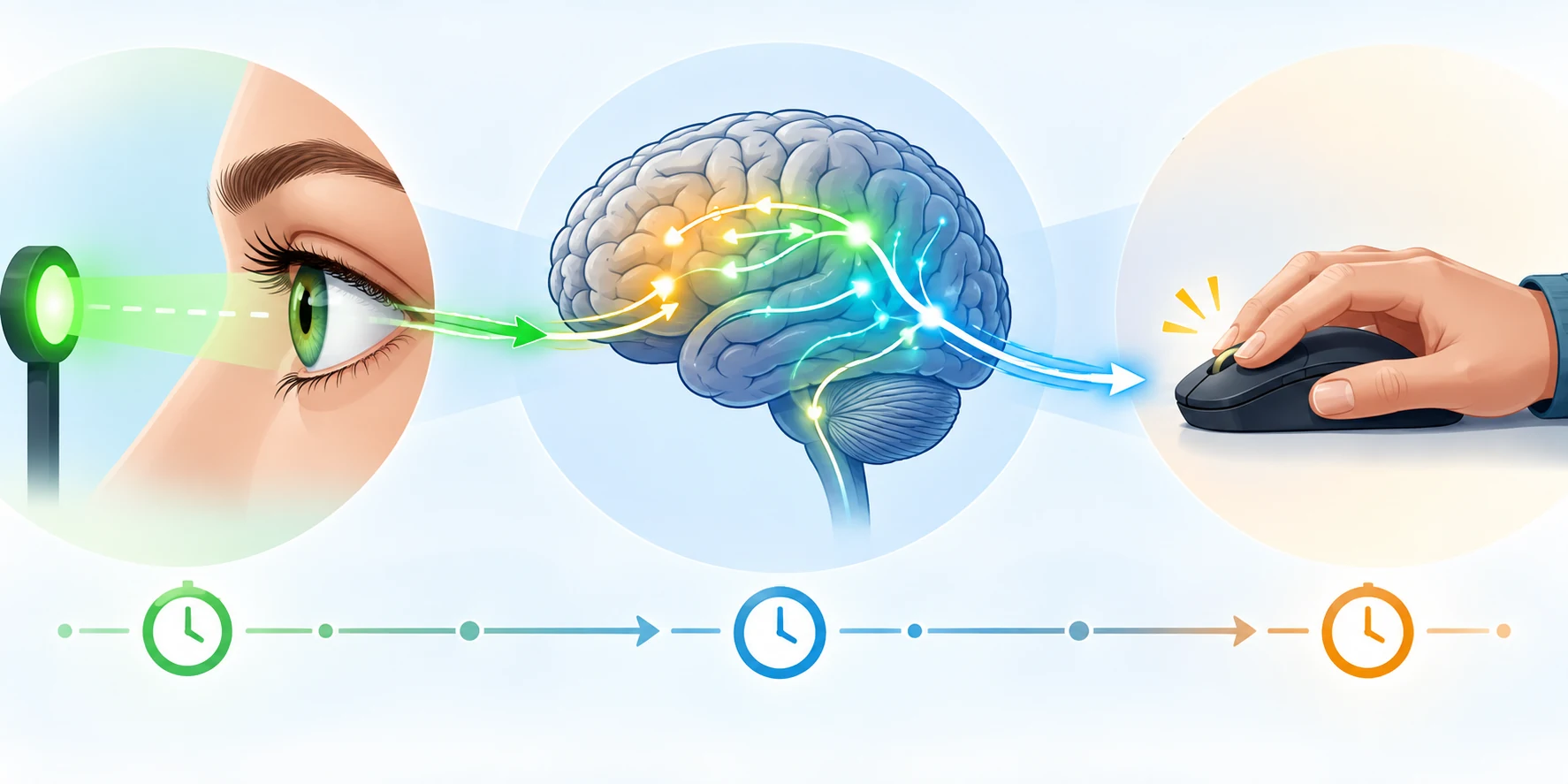
The Short Answer in Milliseconds
For a simple visual cue, such as a screen changing color, many adults land near 200 to 250 ms when using a familiar mouse or keyboard. Scores around 180 to 200 ms are commonly considered fast for browser-based visual tests. Scores below 150 ms are unusual and should be interpreted carefully because anticipation, input timing, display refresh rate, and accidental early movement can make the number look better than the nervous system actually performed.
The phrase "human reflexes" can blur two different ideas. A true reflex, such as a knee-jerk response, is an automatic pathway that can bypass conscious decision-making. A reaction time test usually measures a sensorimotor response: you detect a cue, decide that it is the right cue, and move. That chain is still fast, but it is not the same as a spinal reflex.
Here is a practical benchmark table for simple visual reaction tests:
| Result range | Practical meaning |
|---|---|
| Under 150 ms | Very rare; often worth checking for anticipation or device quirks |
| 150-180 ms | Excellent for a clean visual reaction test |
| 180-220 ms | Fast and common among trained gamers or focused testers |
| 220-280 ms | Typical adult browser-test range |
| 280 ms and above | May reflect fatigue, distraction, unfamiliar hardware, or normal individual variation |
These ranges are educational. The better signal is your average across several clean attempts under similar conditions.
What Happens Inside a Human Reaction
A reaction is not one event. It is a chain. First, sensory receptors pick up a signal: light hits the retina, a sound reaches the ear, or pressure reaches the skin. Next, the nervous system carries that signal toward the brain or spinal cord. Then the brain interprets the cue, selects a response, and sends a motor command. Finally, muscles contract and your input device records the action.
Each step adds time. Visual cues usually require more processing than sound because the brain has to interpret shape, color, location, and meaning. That is why a reaction time score is not just "brain speed." It includes your eyes, attention, decision process, muscles, input device, screen refresh, browser timing, and even how rested you are.
Can a Human React in 0.2 Seconds?
Yes. A 0.2-second response is 200 milliseconds, and that is a realistic fast result for a simple visual cue. Many focused adults can occasionally react around that mark, especially after a few practice rounds. The key word is "occasionally." Consistently averaging 200 ms is more impressive than hitting one lucky 198 ms trial.
In sports, very short response windows create confusion because anticipation can look like reaction. Sprint false-start systems have historically treated movements below 100 ms after the gun as too early to count as a valid reaction. That does not mean no human can ever produce a fast start-like movement; it means that below a certain threshold, timing systems and physiology become difficult to separate from guessing.
For everyday testing, the safest rule is simple: if your best score is much faster than your average, do not build your whole interpretation around the best score. Use median or average values from several clean trials. If you are using a browser-based reaction speed tool, keep the same device, same hand position, same browser, and similar lighting so your comparisons stay meaningful.

Fastest Human Reaction Time in Milliseconds
The fastest human reaction time milliseconds people talk about online often mix valid reaction, anticipation, and specialized starting skills. In a simple visual click test, anything near 120 to 150 ms is extremely fast. Some elite performers in gaming, aviation, or motorsport may show quick responses in highly trained contexts, but those contexts are not identical to a casual browser test.
The main limit is biology. Signals need time to travel through nerves, reach processing areas, and trigger muscles. A person cannot see a new visual cue, consciously interpret it, choose a movement, and complete that movement in zero time. When an online result appears impossibly low, it may be caused by predicting the stimulus, double-click timing, touchscreen behavior, high-refresh hardware, or a test design that permits early input.
So who has the fastest reflexes ever? It depends on the definition. A valid sprint start, a lab reaction task, an esports aim duel, a goalkeeper save, and a start-light drill all measure different blends of anticipation, perception, and movement. For SEO-friendly clarity: the fastest human reactions are usually discussed around the low hundreds of milliseconds, but clean, repeatable visual reactions under 150 ms are rare.
F1 Drivers, Gamers, and Athletes
People often ask, "What is the average reaction time of a F1 driver?" Public benchmarks vary by method, but F1-style starting-light tests often place elite drivers and serious motorsport trainees around the 200 ms neighborhood, with faster individual attempts possible. Driving performance is not only raw reaction. F1 drivers also rely on anticipation, visual scanning, braking precision, steering control, physical conditioning, and thousands of repeated patterns.
Competitive gamers and athletes face the same split. A fast click response helps, but performance also depends on prediction, input latency, aim control, body cues, and decision quality. Pure reaction time is one ingredient inside a larger performance system.
How Fast Are Human Reflexes Compared to Animals?
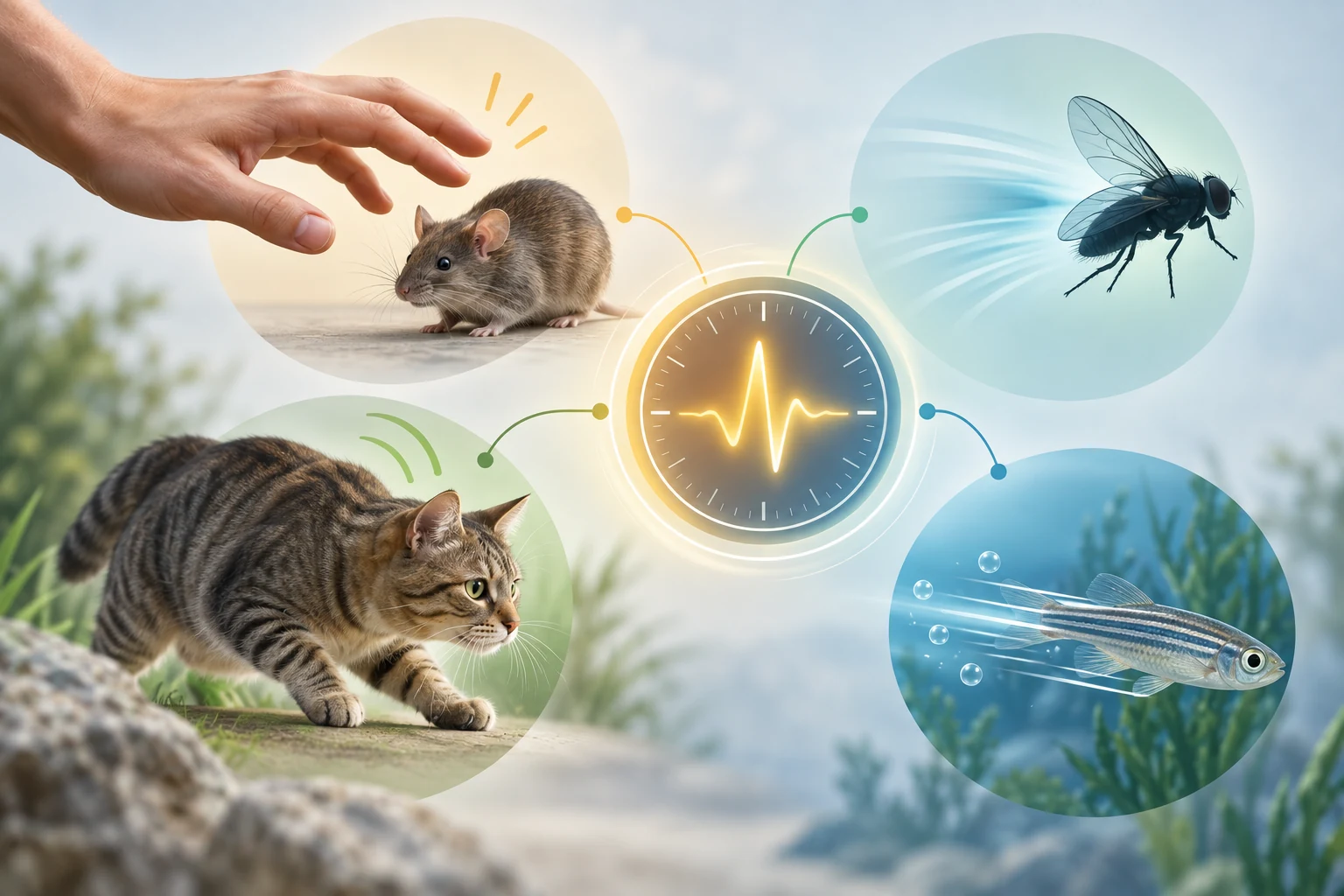
Humans are quick, but we are not the fastest animals. Small animals and insects can respond at astonishing speeds because they have shorter neural distances, different sensory systems, and survival pressures that reward instant escape. Flies, for example, are famous for rapid takeoff responses. Some predatory or prey species process motion faster than humans because their world depends on split-second tracking.
That said, animal comparisons can be misleading. A fly avoiding a swat, a cat pouncing, a fish escape reflex, and a human clicking a mouse are different tasks. The fastest reaction time animal depends on what you measure: startle response, visual processing, strike timing, escape movement, or decision-based reaction.
The fair comparison is this: humans are slower than many specialized animals in raw sensorimotor speed, but humans are strong at flexible decision-making. In real tasks, that flexibility often matters more than a few milliseconds.
How Fast Is Human Reaction Time in MPH?
Reaction time is measured in time, not speed, so it does not directly convert to mph. Miles per hour measures distance traveled per hour. Reaction time measures how long it takes to begin responding after a stimulus appears.
You can connect the two ideas only when distance is involved. For example, at 60 mph, a car travels about 88 feet per second. If a driver takes 250 ms to begin braking, the car moves about 22 feet before the braking action even starts. At 200 ms, it moves about 18 feet. That gap is why small timing differences can matter in driving, racing, and sports.
For nerve signals, mph can describe conduction speed, but that still is not the same as your full reaction time. Nerves may transmit signals quickly, yet perception, decision-making, movement, and device input all add delay. If someone asks for human reaction time in mph, the most accurate answer is that the concept needs a distance or signal pathway before a speed can be calculated.
At What Age Are Reflexes the Fastest?
Reaction speed often improves through childhood and adolescence, tends to be strongest in late teens through young adulthood, and may gradually slow with age. The exact peak varies by task. A practiced 35-year-old gamer may outperform an unfocused 20-year-old on a familiar test, while simple lab averages still show age-related trends over large groups.
Age is only one factor. Sleep, stress, exercise, screen refresh rate, input device, and attention can all shift a result. Your personal trend is usually more useful than a perfect age chart, so compare averages rather than one-off highs or lows.
What Is a Fast Reaction Time and How Should You Measure It?
A fast reaction time is one that is repeatable, clean, and appropriate for the task. For a simple visual click test, under 200 ms is fast for many users. Around 200 to 250 ms is a strong normal range. Above that can still be completely ordinary depending on age, fatigue, device latency, and task complexity.
For better measurements, use this simple checklist:
- Warm up with two or three practice attempts.
- Run at least five clean trials.
- Ignore obvious false starts.
- Compare your average, not only your best score.
- Keep hardware and browser conditions consistent.
- Separate simple reaction tests from choice reaction tests.
Choice reaction tests are usually slower because you must identify the correct cue before acting. A color test where only green counts, for example, measures attention and inhibition as well as speed. A key reaction test adds mapping between what you see and which key you press.
Use Your Reflex Score as a Baseline
The most useful answer to "how fast are human reflexes" is not just a single number. It is a baseline you can retest. If your average visual reaction time is 245 ms today and 230 ms next month under the same conditions, that trend is more meaningful than arguing whether one 177 ms attempt was your true limit.
Use reaction scores as performance feedback. They can help you notice when sleep, focus, device lag, or training changes your consistency. They should not be used as medical proof or as a measure of personal worth. If you are worried about sudden changes in coordination, attention, or daily functioning, it is reasonable to speak with a qualified professional.
For an easy starting point, explore the reaction time testing homepage and track a few repeat sessions. Treat the result as a practical snapshot: useful, repeatable, and most valuable when compared against your own previous scores.
FAQ
Can a human react to 0.2 seconds?
Yes. A 0.2-second reaction is 200 ms, which is a realistic fast response for a simple visual test. It is more meaningful if you can repeat it across several clean trials rather than hit it once.
What is the speed of human reflexes?
For common visual reaction tests, many adults score around 200 to 250 ms. True automatic reflexes can follow different pathways, so they should not be treated as identical to click-based reaction time.
Who has the fastest reflexes ever?
There is no single universal answer because different records use different tasks. Elite athletes, trained drivers, and competitive gamers can show very fast responses, but task rules and anticipation matter.
What is the average reaction time of a F1 driver?
F1-style benchmark tests often place elite motorsport reactions around roughly 200 ms, with variation by test design. Driving performance also depends on anticipation, precision, fitness, and decision-making.
What animal has the fastest reaction time?
Some insects and small animals can react faster than humans in specific escape or startle tasks. The winner depends on whether the test measures visual processing, startle movement, strike timing, or full-body escape.
At what age are your reflexes the fastest?
Many simple reaction tasks are strongest from the late teens into young adulthood, but practice, sleep, attention, and device setup can outweigh age in day-to-day results.