Does Exercise Improve Reaction Time? Acute Effects vs. Long-Term Training
November 3, 2026 | By Marcus Adler
Exercise can improve reaction-task performance under some conditions, but a faster score after one workout does not show that your reactions have permanently changed. The useful distinction is between an acute effect, measured around a single session, and a training effect, examined after repeated exercise over weeks. Both also depend on what the test asks you to do. If you use a simple reaction time test to explore the question, treat it as a repeatable observation rather than proof of a training benefit. This guide explains what selected studies found, why their results differ, and how to make a more meaningful before-and-after comparison.
A Faster Reaction Means a Shorter Reaction Time
When people ask whether exercise "increases reaction time," they often mean whether it makes reactions faster. The direction matters: a shorter time is a faster response on the same task. An increase from 240 to 260 milliseconds means the recorded response became slower.
These example values are illustrative, not fitness benchmarks. A change has meaning only after you check the task, accuracy, testing conditions, and whether it repeats.
Exercise research may measure responding to a signal, selecting an answer, ignoring a distraction, or withholding an incorrect action. Those outcomes should not be treated as interchangeable. A study involving a decision task cannot directly predict how many milliseconds you will gain on a color-change click test.
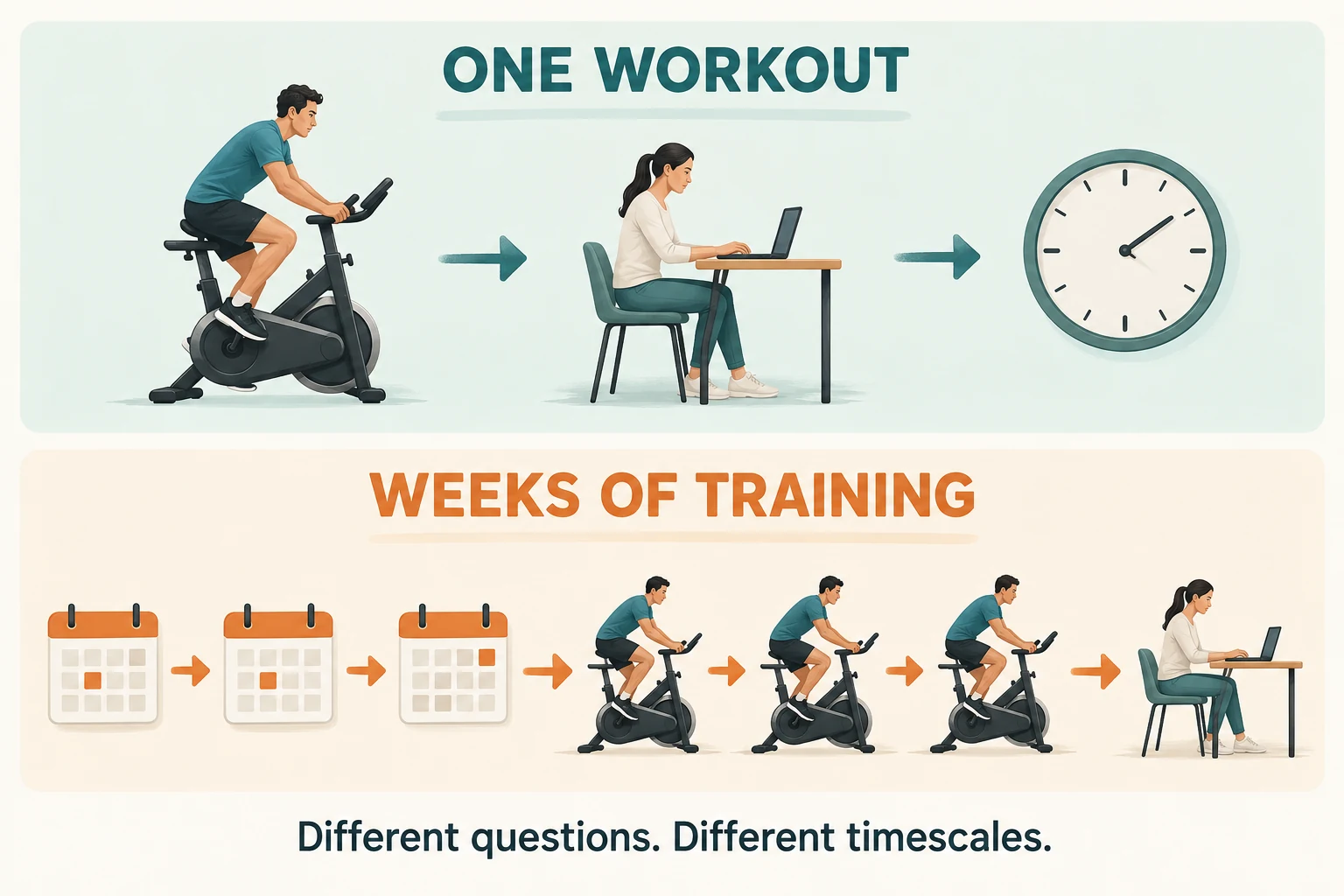
One Workout and Weeks of Training Answer Different Questions
An acute exercise study examines performance during or after a particular workout. A training intervention measures change across a period of repeated exercise. A comparison between active and inactive people is a third design: it describes differences between groups without necessarily showing what caused them.
| Research question | What is compared | What the result cannot establish by itself |
|---|---|---|
| Does one session change performance? | Tests around exercise and a comparison condition | A lasting training effect |
| Does a training program change performance? | Outcomes before and after repeated sessions, ideally with a suitable comparison group | That every reaction task improves |
| Do active people perform differently? | People with different activity levels | That exercise caused the difference |
For your own records, decide which question you are asking before testing. Immediate workout effects and changes in a rested baseline need separate comparisons.
What Studies Found After a Single Exercise Session
Cycling improved one complex reaction task
Guzman and Lopez-Garcia's 2016 paper, Acute effects of exercise and active video games on adults' reaction time and perceived exertion, compared resting with cycling and cycling combined with an active video game in young adults.
The exercise sessions lasted 30 minutes. Both exercise conditions improved complex reaction-time performance, while resting did not. Adding the active video game did not produce a greater reaction-time improvement than cycling alone.
The finding supports a short-term effect for that population, task, and protocol. It does not establish that a walk, a lifting session, or a browser click test will produce the same result. Nor does the study turn 30 minutes into a universal exercise prescription for faster reactions.
Another benefit did not persist through a 30-minute recovery
Netz and colleagues' 2016 study, Acute aerobic activity enhances response inhibition for less than 30 min, examined 40 healthy, active middle-aged adults. Participants completed a Go-NoGo task and a catching task before exercise, immediately afterward, and after a 30-minute recovery period, with a control condition for comparison.
Go-NoGo performance, including reaction time and accuracy, improved immediately after moderate aerobic exercise. The catching task did not show the same improvement, and the inhibitory-control benefit was not maintained at the 30-minute follow-up.
This is a useful example of task-specific and temporary results. It does not mean every exercise benefit disappears after exactly 30 minutes. It means a result measured immediately afterward cannot be assumed to persist at a later time.
Does Regular Exercise Improve Reaction Time Over Weeks?
A longer training period still requires careful interpretation. Scott and colleagues' 2026 randomized trial, published in Frontiers in Sports and Active Living under the title beginning Better together, followed 107 young adults over 12 weeks. It compared stationary cycling alone with physical and cognitive training performed together or separately.
Response speed improved across groups on several tasks involving executive function, including visual search, Stroop, and category switching. However, accuracy also changed, and reaction time on the Psychomotor Vigilance Task became slower across groups. The physical-only group performed less favorably on vigilance measures than the combined-training groups.
Because all groups received active interventions, improvement over time alone does not isolate the effect of exercise against doing no training. The mixed task results also resist a blanket claim that regular exercise makes every response faster.
Name the outcome you want to follow; one click test does not measure your entire reaction ability.
Why a Post-Workout Score Can Be Misleading
A before-and-after test changes more than your exercise status. By the second round, you have already read the instructions and practiced the response. You may have changed your posture, concentration, or willingness to take risks with early clicks. The elapsed time is different too.
Testing after a workout also requires a clear timing rule. "After exercise" could mean immediately, after a shower, or an hour later. If that interval varies between sessions, your records describe different situations.
Consider a hypothetical session: your median score is 245 ms beforehand and 232 ms afterward. It is tempting to label the difference a 13 ms exercise benefit. But without repeated sessions and a no-exercise comparison, you cannot separate exercise from test familiarity and ordinary variation.
Before drawing a conclusion, check three questions:
- Was the response valid? Anticipating the cue can create an impressive number that does not represent a correct reaction.
- Did accuracy change? Faster responses accompanied by more mistakes need a different interpretation.
- Does the pattern repeat? One favorable session is a reason to keep observing, not a reliable estimate of a lasting effect.
How to Compare Reaction Time Before and After Exercise
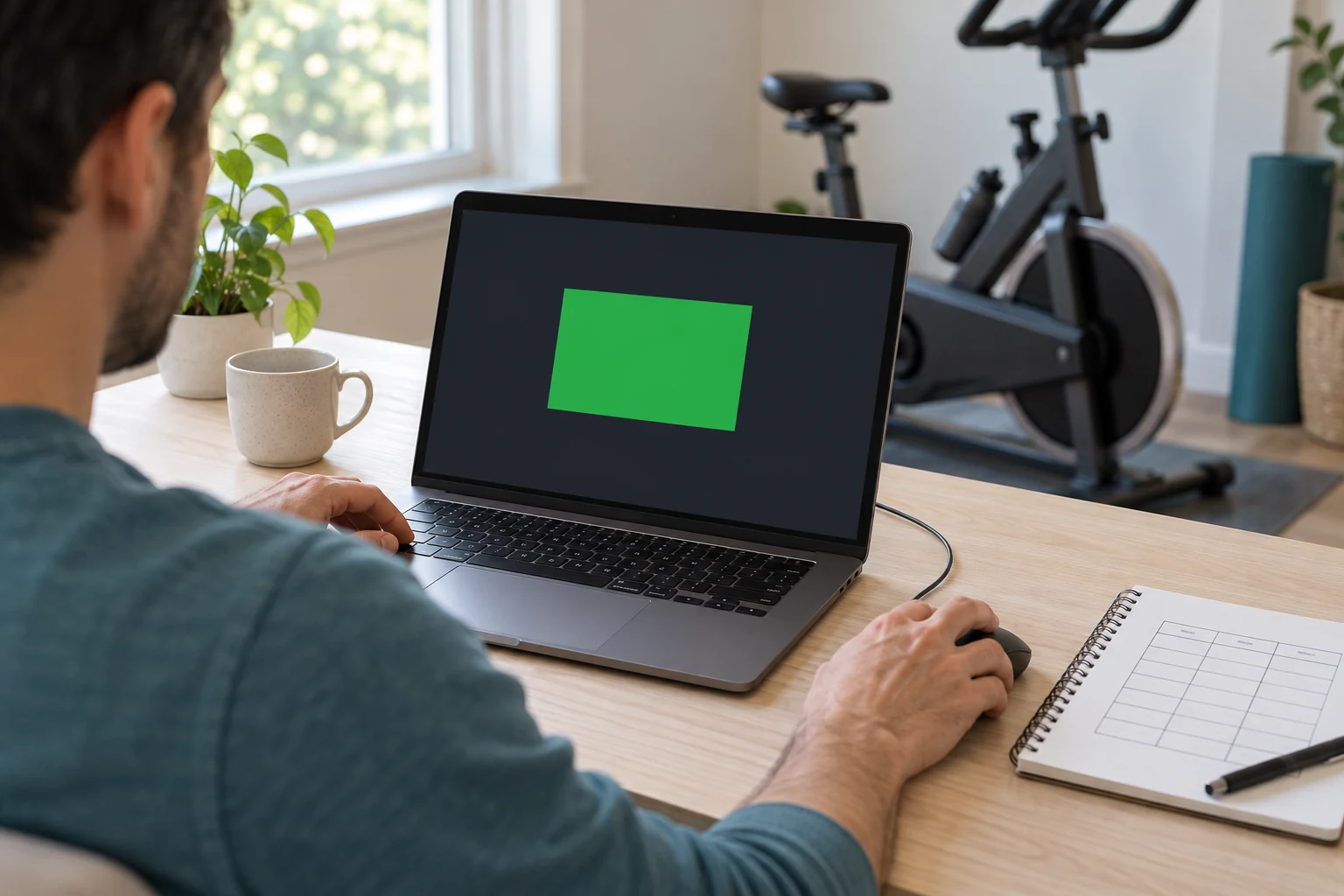
You can use the online reaction speed test for a small, consistent visual-response task. The recorded interval includes screen and input timing, so use the same equipment throughout. This is an educational comparison, not a laboratory experiment or a way to decide how hard you should exercise.
Set the procedure before collecting scores
- Choose one task and setup. Keep the browser, device, input method, hand, and test mode fixed.
- Familiarize yourself first. Complete practice attempts before the tracking period, then use the same short warm-up each session.
- Choose a fixed trial count. For example, record 10 valid attempts per measurement and calculate the median. Ten is a practical tracking choice, not a research standard.
- Define the recovery interval. Pick a manageable interval after an ordinary workout and record it. Keep that interval consistent when comparing similar sessions.
- Add a quiet comparison session. On another comparable day, replace the workout period with seated rest for the same duration. Repeat the same test schedule.
- Repeat both conditions. Compare patterns across several days rather than relying on one workout and one rest session.
Perform screen tests while seated and stationary. Keep your exercise routine within your usual ability; increasing effort simply to chase a lower score makes the comparison less useful.
Record enough context to interpret the result
| Field | What to note |
|---|---|
| Test setup | Device, mode, input method, and trial count |
| Before and after | Median score for each measurement |
| Errors | Early clicks, missed cues, or wrong responses |
| Exercise or rest | Activity, duration, and perceived effort |
| Timing | Time of day and minutes between activity and retest |
| Session context | Unusual sleep, distractions, caffeine changes, or interruptions |
To describe change, subtract the before score from the after score. In the hypothetical example above, 232 minus 245 equals -13 ms. The negative value describes a faster recorded response; it does not establish the cause.
If both exercise and rest sessions improve similarly, repeated testing is one plausible explanation. If the exercise pattern differs consistently, you have a more interesting personal observation. You still have limited control over expectations and day-to-day conditions, so avoid presenting it as a proven causal effect.
Keep Immediate Effects Separate from Your Rested Baseline
If you want to track a training habit over weeks, collect baseline measurements under a separate, consistent rested condition. Comparing a rested score in week one with a post-workout score in week six mixes the training timeline with the immediate testing situation.
Choose a convenient schedule, such as the same time on a comparable day each week, and keep its relationship to exercise similar. Use the same task, practice routine, trial count, and error rules throughout. Note equipment changes rather than silently treating a new setup as equivalent.
Review session medians together instead of selecting the best day. A gradually changing pattern is more informative than an isolated record. Even then, a personal trend cannot separate exercise from ongoing test practice, changing routines, or other influences as well as a controlled study could.
Use Exercise and Reaction Testing with a Clear Question
Does exercise improve reaction time? The studies discussed here support a qualified answer: some exercise conditions improve selected outcomes, but the timing, task, and accuracy matter. Evidence from one workout cannot substitute for evidence about repeated training.
For a useful next step, choose either an immediate before-and-after comparison or a rested trend across weeks. Keep the procedure small enough to repeat. The visual reaction time tool can support that record, alongside notes about exercise and testing conditions.
Let the results help you ask better questions rather than set your exercise intensity or judge your overall fitness. If your goal is a particular sport, also assess the decisions and movements that matter in that activity; a screen response samples only a narrow task.
FAQ
Does exercise increase or decrease reaction time?
An improvement in reaction speed means a decrease in reaction time on the same task. Some exercise studies report that result under specific conditions. An increase in the recorded milliseconds means a slower response, so check which meaning a headline intends.
Can one workout improve reaction time immediately?
Yes, selected studies have found immediate benefits on particular tasks. That does not predict your result after every workout. Keep the task, recovery interval, and testing procedure consistent when exploring your own pattern.
How long does a post-exercise improvement last?
There is no universal duration established by the studies discussed here. In the Netz study, the response-inhibition benefit was not maintained at the 30-minute follow-up. That finding applies to its protocol and participants rather than all exercise sessions.
Does long-term exercise make every reaction faster?
No general promise follows from these results. The 12-week trial discussed above found different directions of change across cognitive tasks. Track the specific response you care about and include accuracy when interpreting progress.
Should I exercise harder to get a better score?
A browser score is not a basis for increasing exercise intensity. More effort does not follow logically from a better result under one study protocol. Use an ordinary, manageable routine for tracking and keep the testing conditions repeatable.
Why did my score improve on a rest day too?
Repeated testing can make the instructions and response more familiar. Other session conditions may also differ. This is why a rest comparison is useful: improvement without a workout shows that a before-and-after change need not be caused by exercise.