5-Step Reaction Time Training Plan: Beginner to Advanced
January 26, 2026 | By Marcus Adler
Do you ever feel like your reflexes are just a split-second too slow? That frustration is common, especially in moments where speed matters most—in competitive gaming, sports, or even driving. You might have already taken a reaction time test and seen your score in milliseconds. But the big question is, now what?
This guide is your answer. We will turn your test results into real, measurable improvement. Forget random tips; this is a structured, 5-step training program designed to sharpen your reflexes. It's built for everyone, from beginners looking to gain a basic edge to advanced users chasing elite-level reaction speeds. The first step is knowing where you stand, and you can establish your baseline right now with our free reaction test.
Building Your Foundation: The Reaction Time Training Program
Before jumping into advanced drills, it's crucial to build a solid foundation. A structured reaction time training program isn't about mindlessly clicking a button faster; it's about systematically training your brain and body to work together more efficiently. This involves understanding the science, setting up your environment, and getting an accurate starting point.
Understanding the Three Phases of Reaction Time Development
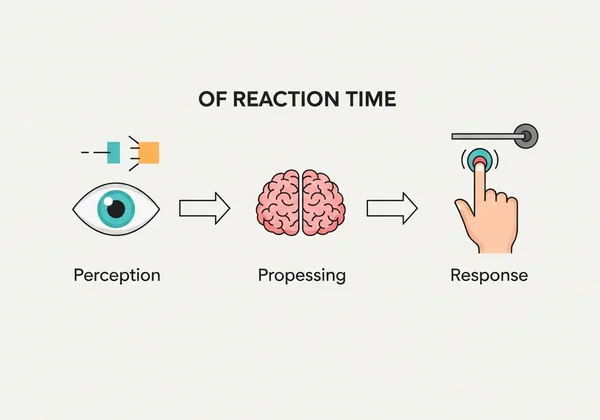
Your reaction time isn't a single event. It's a three-part process that happens in a fraction of a second:
- Perception: Your eyes see a stimulus (like a color changing from red to green).
- Processing: Your brain identifies and interprets this signal.
- Response: Your brain sends a signal to your muscles to act (to click the mouse).
Effective training targets all three phases. You will learn to perceive signals faster, process information more efficiently, and execute a physical response with minimal delay. Understanding this helps you train smarter, not just harder.
Essential Equipment and Environment Setup for Optimal Training
To get reliable results from your training, you need a consistent environment. External factors can easily add milliseconds to your score, giving you a false reading of your actual ability.
- Your Equipment: Use the same mouse and monitor for every session. A gaming mouse and a monitor with a high refresh rate (144Hz or higher) can reduce hardware delays, but consistency is more important than having the best gear.
- Your Environment: Train in a quiet, well-lit room with minimal distractions. Turn off notifications on your phone and computer. Sit in a comfortable, upright posture that you can maintain consistently. This focus ensures you're measuring your reaction, not your distraction level.
Measuring Your Baseline: Using ReactionTimeTest.net for Initial Assessment
You can't improve what you don't measure. The first practical step in any training program is to find out your starting point. This is where our tool comes in. It provides an instant, accurate measurement of your current visual reaction time.
Before starting the program, take the test five times and calculate your average score. This number is your baseline. Write it down. It's the benchmark you'll use to track your progress and see the tangible results of your hard work. Ready to find your number? Start your test now.
Progression Framework: From Beginner to Elite Reaction Speed
This 5-step framework is designed to guide your reaction speed progression over several weeks. Each step builds on the last, taking you from fundamental neural activation to performing under pressure. Follow the timeline, but also listen to your body—consistency is key.
Step 1: Neural Pathway Activation (Weeks 1-2)
The goal here is simple: get your brain and fingers talking to each other as fast as possible. This phase is about repetition and building the basic connection between seeing a stimulus and reacting.
- The Drill: Use the reaction time test on our homepage. Perform 20-30 tests daily.
- The Focus: Don't worry too much about your scores yet. Focus on the physical act of clicking immediately after the color changes. You are carving a "superhighway" in your nervous system.
Step 2: Pattern Recognition Training (Weeks 3-4)
Most real-world scenarios aren't just about reacting to a single, simple cue. They involve recognizing patterns. In this phase, you'll train your brain to identify relevant signals faster.
- The Drill: Continue with daily tests, but now pay attention to the feeling of readiness. Try to anticipate the change without clicking too early. You can also use online "choice reaction time" trainers that ask you to click only when a specific color or shape appears.
- The Focus: You're training your brain's processing phase. The goal is to reduce the time it takes to decide, "Yes, that's the signal I need to act on."
Step 3: Anticipatory Reaction Development (Weeks 5-8)
Elite performers don't just react; they anticipate. This advanced skill involves learning the rhythm and probability of events to prepare your response before the signal even appears.
- The Drill: Introduce variability. If you're a gamer, use in-game training modes. If you're an athlete, practice with a partner who can give you unpredictable cues. For general training, try to predict the timing of the color change in our test, but without "jumping the gun."
- The Focus: This is a mental game. You are learning to enter a state of relaxed readiness, primed to act but not tense.
Step 4: Stress-Resilient Reaction Training (Weeks 9-12)
It's one thing to have fast reactions in a quiet room. It's another to maintain them under pressure. This phase introduces controlled stressors to make your newfound speed reliable when it counts.
- The Drill: Practice your reaction tests while listening to distracting music or crowd noise. Set a "high score" goal for a session and create pressure for yourself. Compete with a friend's score.
- The Focus: You are training your nervous system to stay calm and efficient, preventing stress from hijacking your performance.
Step 5: Elite Performance Maintenance (Weeks 13+)
Once you've significantly lowered your reaction time, the goal shifts to maintenance. Like any physical skill, you must continue practicing to keep your edge.
- The Drill: Reduce your dedicated training to 3-4 sessions per week. Focus on quality over quantity. Use the reaction test as a warm-up before gaming or sports.
- The Focus: Consistency. Regular check-ins ensure your neural pathways stay fast and efficient. Periodically see your results to make sure you're staying sharp.
Beginner Reflex Exercises: Starting Your Improvement Journey
If the full program seems like a lot, don't worry. You can start with these simple beginner reflex exercises. They are easy to incorporate into your daily life and will begin sharpening your reaction skills right away.
The Color-Change Drill: Mastering Visual Reaction Cues
This is the most fundamental exercise, and it directly relates to our online tool. The goal is to isolate and improve your response to a visual cue.
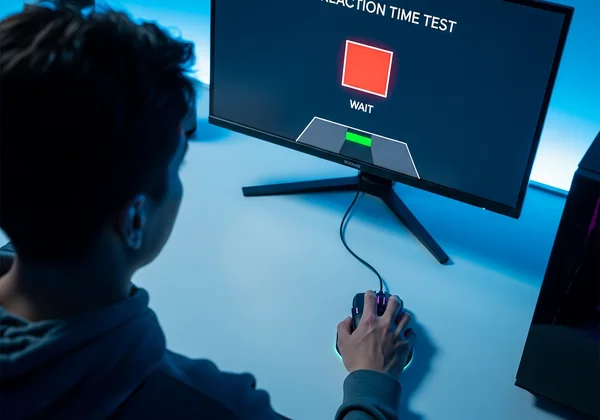
Spend five minutes each day on our homepage. The task is simple: click as soon as the red box turns green. This drill trains the core components of reaction time. It's like a gym workout for your reflexes, building foundational strength for more complex tasks.
Audio-Visual Integration Training for Multi-Sensor Processing
In many situations, you react to both sights and sounds. This exercise trains your brain to process multiple types of information at once.
Try this: Have a friend stand behind you and either clap their hands (audio cue) or drop a colorful object in front of you (visual cue). Your job is to perform a specific action, like catching the object or clapping back, as fast as possible. This helps your brain integrate different sensory inputs.
Simple Daily Routines for Consistent Reflex Enhancement
You can train your reflexes without any special equipment. Simple habits can make a big difference over time.
-
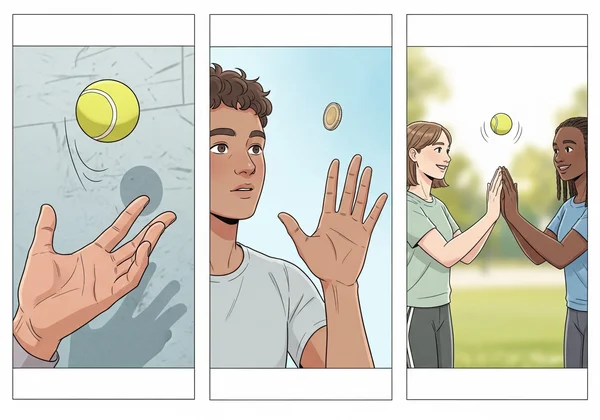
The Ball Drop: Stand near a wall and hold a tennis ball at shoulder height. Let it go and try to catch it after one bounce. To make it harder, use a smaller, bouncier ball.
-
The Coin Snatch: Place a coin on the back of your hand. Toss it up slightly and catch it with the same hand. This improves hand-eye coordination and reaction speed.
Putting It Into Practice: Your Training Journey Begins Now
With the right approach, anyone can improve their reaction time. This isn't some innate gift only top athletes and gamers possess—it's a skill you can develop with dedicated practice. By following a structured plan, you can transform your reflexes from a point of frustration into a source of confidence.
We've covered the science, the setup, and a complete 5-step framework from beginner to advanced. The key takeaways are to be consistent, measure your progress, and systematically challenge yourself. Your journey starts with a single, simple action: finding your baseline.
Now it's time to put this knowledge into practice. Go to the homepage, establish your starting score, and begin your journey to faster, sharper reflexes today. Your future, faster self will thank you. Ready to get started? Try our free tool now.
Frequently Asked Questions About Reaction Time Training
What is considered a good reaction time for athletic performance?
For the general population, the average reaction time to a visual stimulus is around 250 milliseconds (ms). However, for athletes in fast-paced sports, a "good" time is significantly lower. Competitive gamers and professional athletes often have reaction times between 150-200ms. Some elite performers can even dip below 150ms. Remember, these are just benchmarks; the most important thing is to track your own improvement.
How quickly can I realistically expect to improve my reaction time?
With consistent training, like the plan in this article, most beginners can see a noticeable improvement of 20-50ms within the first 4 to 8 weeks. Progress will be faster at the beginning and slow down as you approach your genetic potential. Don't be discouraged if your improvement plateaus; that's a normal part of training.
Does FPS (frames per second) affect reaction time training results?
Yes, absolutely. FPS affects reaction time because a higher frame rate updates the image on your screen more frequently. A monitor running at 144Hz shows a new frame every 6.9ms, while a 60Hz monitor takes 16.7ms. This means a high-FPS setup can deliver the visual cue to your eyes faster, potentially lowering your score. For consistent training, it's best to always use the same equipment.
What's the difference between reaction time and reflex speed in training contexts?
Though often used interchangeably, they are slightly different. A reflex is an involuntary and nearly instant movement in response to a stimulus (like pulling your hand from a hot stove). Reaction time involves conscious processing; you must perceive the stimulus, process it, and then choose to react. Our training program and the reaction speed test on our site primarily measure and improve your conscious reaction time.